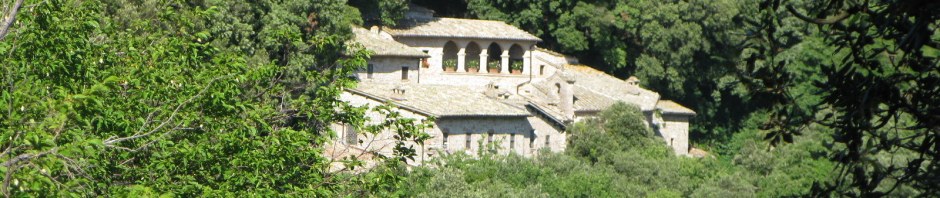
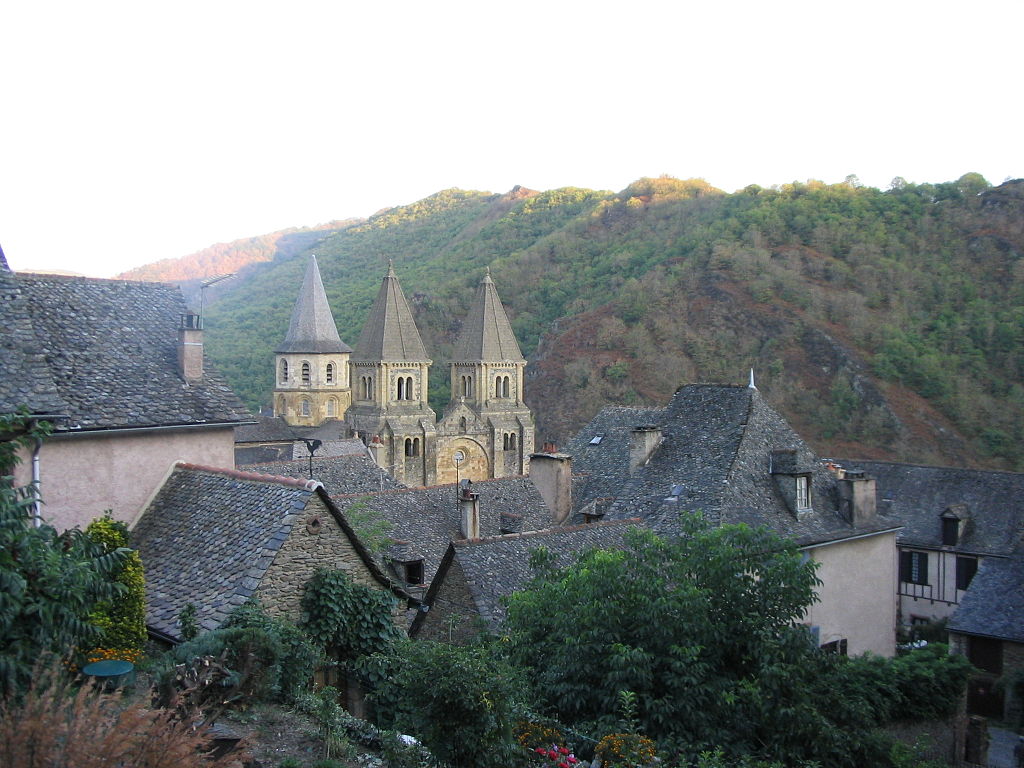
It had been 30 years since I first thought about walking the Camino. Did it all start in 1987, when we walked into the small French mountain village of Conques at 10 pm on a cold February night?
Just two street lights barely illuminated the cobblestone street descending into Conques. The town was eerie-dark and too quiet, shut-tight in the late winter cold. We had spent the day visiting pilgrimage churches in France, situated one day’s walk apart on the Camino de Santiago, all with a 4-month-old baby in tow. Conques, famous for its 11th century Abbey Church of Sante-Foy, was our destination, but too quickly the day had grown late, dark and cold. We came to Conques seeking to understand why and how medieval pilgrims made the thousand-kilometer journey, walking from central Europe to worship at the church of St. James the Apostle, Santiago de Compostela, on the north coast of Spain.
Now, in need of dinner and shelter for the night, we left our rented car at the top of the town. Conques roads were too narrow for even small cars. Our winter jackets were no match for the damp cold rising up through the streets from the Dourdou River which ran below the town. The baby slept strapped to my chest, inside my down coat. He at least was warm.
Rushing water and night owls were the only sounds in the medieval streets. Fog swallowed the tops of Conques’ two-story houses. We began to despair of finding lodging within the barricaded buildings. No inns. No restaurants.
 Then at the bottom of the town, just as we were about to turn around, a light appeared through the fog. Voices came from a stone tavern that seemed to lean out over the river. Did they have a room? Yes, but without heat. And the tavern was about to close. No dinner. We paid for lodging and climbed the winding stairs to the small room, with the sound of rushing water under its floorboards. The baby nursed then slept swaddled in his snowsuit and secured in a dresser drawer. We climbed beneath a mountain of blankets, hungry, huddling to keep warm and lulled by the water rushing below.
Baby Sam woke us at daybreak. Hungry, always hungry. Finally the tavern opened to provide hot café with a pitcher of steaming milk. The bread, butter and homemade jam tasted beyond good.
With Sam strapped again in his carrier, we headed out the door to climb back up through Conques to the Abbey Sante-Foy.
History says that some 250,000 pilgrims made the two-month journey each year in the Middle Ages. They traveled on foot, stayed in hostels run by monks and nuns, venerated the relics housed in churches along the way, and walked-on, across Spain, to touch the sarcophagus of St. James, and thus touch apostle who shared the earth with Jesus Christ.
Thirty-one years later
Thirty-one years would pass before we’d undertake the walk ourselves, and then only the last 127 kilometers from Saria, Spain into Santiago de Campostela. Our daughter Katie would walk with us.
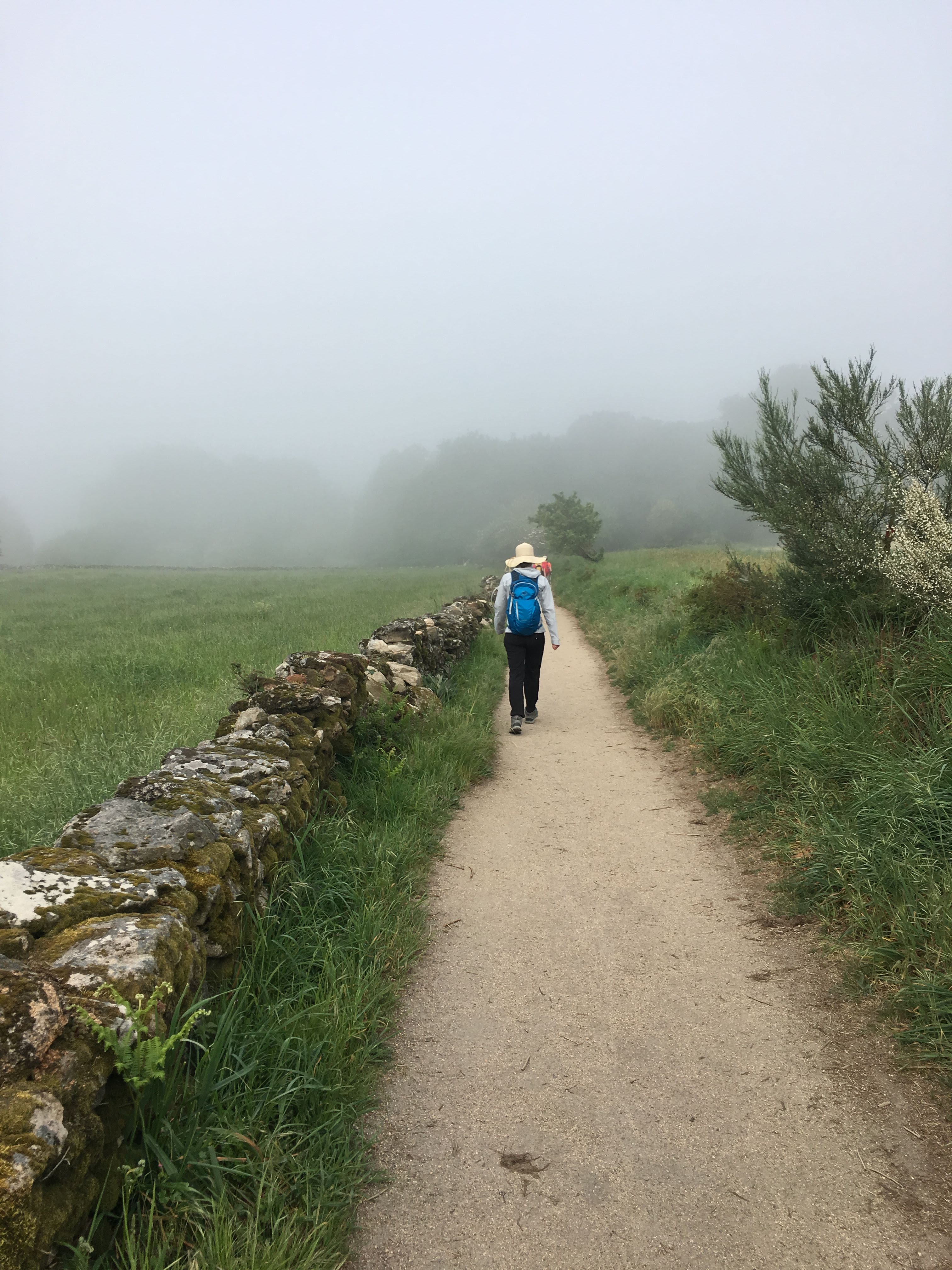 So why walk? Yes, as history nerds we have a passion to relive the middle Ages. But, that cold drizzling morning when we walked from our hostel, down the lane to join the Camino, the realization hit. This wasn’t just a 90-minute walk around the neighborhood. No, we were walking to reach our next bed.
The five-foot wide path lined by stone walls wound across farm lands. We crossed a stream, then a road clearly used by farm animals and tractors. The path entered a wood and we came upon our first stone Camino marker. Only 122.4 km to Santiago de Campostela. These markers, with the shell image would become our friends, offering reassurance that we were still on the path.
We walked through small villages with three to four houses and a church. We passed other pilgrims and pilgrims passed us. That first day, we tried to walk up over a mountain to reach our next hostel and became terribly lost. The day grew hotter. William and Katie were well ahead up the road, determined to walk at a fast pace. Suddenly two snarling dogs bounded up from the adjacent farm. Barking frenetically, they worked as a team. Realizing that to turn my back was to invite an attack, I faced them walking backwards up the hill, yelling at them to go home, and waving my walking stick. When William came running, they gave up.
Hot. Climbing a road that wasn’t on the map, but seemed to head in the direction of our next inn, we realized we might be lost. Retrace our steps or continue?
 Then an eighty year-old angel, driving a loud, beat-up Renault with chorizos on the back seat stopped. “Are you lost?” she asked in her toothless Spanish. “Where are you going?” We indeed had climbed the wrong hill and were 6 kilometers from our destination. “Get in,” she urged, and we did. William and Katie opted to sit atop the chorizos, leaving me to converse up front. The poor car barely made 20 kms per hour as it chugged up hill. She loved the fact we were American, and that she could help us, although after 15 minutes she began to worry about the weight in her laboring car. Finally, she let us out at a cross-road, waiving dramatically for us to walk ahead – just 2 kilometers. Down, up, down, past a church to the road for Morgade.
Reflections on Why We Walk
Here are my notes scribbled at the end of the day with tired feet and heavy eyelids:
Walking the Camino was different. It wasn’t just walking, it was a personal journey, a time to honor the thousands and thousands who have walked before us.
We walk to smell the pungent sweet smell of Eucalyptus trees that formed these special woods. To take time and really look, as you walk through four-house villages clinging to their country way of life.
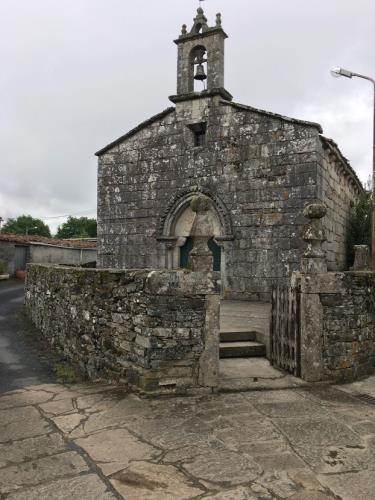
We walk to feel God’s presence in the woods, the farm lands, on top of the hills, and in the tiny medieval churches that dotted the path. We walk in memory of those we’ve loved and loss. We walk to be still with oneself, in solitude, calming the mind to focus on steps. We walk to push your body for it was meant to walk; feel exhaustion. Your body becomes your closest companion, your oldest friend, it is conscious of the path under your feet.
 We walk to take pictures on a Roman Bridge heading into another medieval town. We walk to have our Pilgrim’s Certificación de Paso stamped.
The birds! We walk to watch them swoop, dive, flutter and call to each other. We walk to hear the symphony of frogs croaking in the low lying marshes beside the trail. And the cows wailing and the dogs barking and the wind moving through eucalyptus trees to create the click-clicking sound of rain.
We walk to smell: the wild chamomile flowers and the lavender, but also the cow dung and manure-fertilized fields. We walk alongside the cows as they head to be milked.
We walk to see stone crosses and medieval churches, to descend into villages untouched by our century. To have our passports stamped by priests and tavern owners.
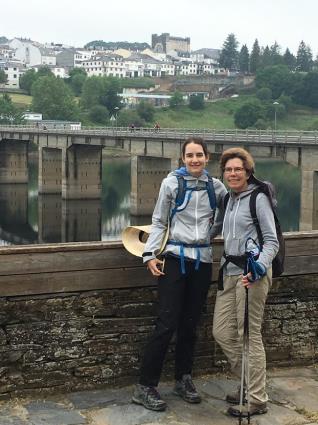 We walk to arrive at a hotel, our bodies aching from exhaustion, our feet starting to blister. To shiver under blankets when our bodies say we’ve pushed them too far. To find a cold beer or glass of Alberino prior to a hearty farm-cooked dinner. To wake the next morning and head back out onto the Camino in the cold and damp morning.
The colors of nature draw us onward. Ferns carpeting the forest floors. Flowers growing wild in fields. Green fields, blue sky and gray rock of building.
We walk to pass a farmer with his scythe cutting grass by the roadside as did his father and grandfather who came before. We walk to pass a heavy-set seventy-year-old Spanish women in journey-worn clothes. With a pack on her front and backpack on her back, she plods along on a quest that clearly was religious and deeply personal. Unlike us, she was carrying her belongings and probably sleeping on the trail. Her faith was strong.
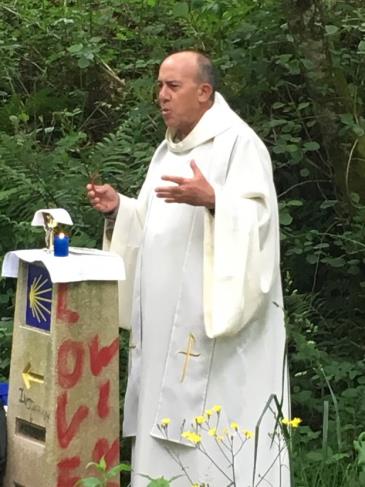 We walk to come upon a priest, saying mass on a Sunday morning along the path. He used the Camino marker as his altar and preached of honoring God by honoring nature and these special woods. He gave communion to the faithful who had stopped to attend his woodland mass, often kneeling in the moss as we prayed together.
We walk to finally travel up into the town, through the medieval streets, then down under and archway and finally emerge onto the square before the Cathedral of Santiago de Campostella. We collapsed on the warm pavement, among hundreds of other pilgrims. The day’s shadows were growing longer and a coolness had set in. But the large granite paving stones retained their warmth and sifted up through our tired bodies.
 Your Words Matter