The urge to be outside in the morning light and hike pulls me from the dark of our 500-year old stone house, down our cypress-lined gravel drive, through our gate and to the road for the 2 kilometer morning walk to Collepino. Our stone shepherd’s cottage is on the road up from the hill town of Spello, a small city in Umbria, to the even smaller medieval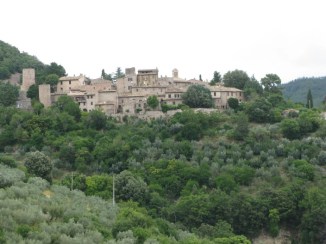 hamlet of Collepino (translated hill of the wolves – Colle di volpino).
Collepino traces its origins to the 6th century, but was mostly built in the 11th century.
The road winds seriously up, hugging the mountain with terraced groves of olive trees holding the steep slope in place. Smells of burning wood and cut hay fill the morning, broken occasionally by the hint of a cool breeze.
The sun is hot and I’m walking at a good pace as the road climbs. I find myself breathing hard and sweating before reaching the halfway mark. Two men – probably my age or older, pass me on their touring bikes riding up the mountain in the easiest gear. Both are dressed as for the Tour de France, in their full colorful biking outfits. “Buona passeggiata,” the second says to me, obviously acknowledging that I too am exerting myself to get to the top. “Salve,” I reply, wishing I was more fashionably dressed than in my American shorts and blue jeans shirt. Together bike and outfit probably cost more than fifteen hundred dollars. As usual, in Italy it’s important to look good if you’re going to exercise.
Walking to Collepino in the mornings is a time to think, to try to memorize each detail of the amazing landscape, store it inside for later writing.
Perched atop a mountain spur, 600 meters above the valley floor sits the two-street 11thcentury walled town of Collepino. I enter through its stone arched gate and stop at 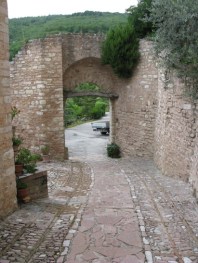 the small fountain to drink from its spigot. Water runs from the bronze lion head spout into the marble basin below, a sign that the town possesses that valuable life resource: water. Rose colored stone buildings line the steep narrow street, also paved in this beautiful rose stone. I climb into the town, twenty-five meters from the gate to the church. Unfortunately, the church like so many in Italy is sempre chiuso. My path on the inner street circles the church, leading back to the gate. After completing this circuit to cool down and let the perspiration dry, I head down the smaller side street, following the signs to the “Bar,” which is situated in a small piazza.
Collepino has two businesses and probably 50 occupants. One is the “bar,” where I am now known to the bar owner. “Buon giorno. Un caffe per favore e un bicchiere di acqua.” As he hands me a glass of water and fixes my espresso, he tells me about the “festa” they had in Collepino last night. We had heard the music after returning from dinner and a very bad concert of the Leeds Youth Orchestra in Spello. “Was the music annoying?” he asks, concerned that their festa might have disturbed us.
“No, no,” I reply. At which point he tells me there were young and old all dancing in their small piazza, and having a wonderful time. In fact, he didn’t get to bed until 4 a.m. He laughs when I tell him the orchestra concert we attended in Spello “non era tanto bello,” the music was not very beautiful. And that we would have been better to come to Collepino. Next time. Since he is cleaning the bar and washing the floor to get ready for the day’s business, I leave a one euro coin on the counter and start to walk out.
“Wait Signora,” he says running around behind the bar. “You need il resto, your change.” I say something about 10-cents not being worth anything. “Oh no, you’re wrong,” he explains with a laugh, as he goes on to say how 10 cents plus 10 cents plus 10 cents all add up to the grander things in life. A lovely philosophy for the day.
With my jolt of caffe, I’m ready to walk back through the town gate and down the mountain. The sun is higher and hotter, but I find myself smiling, thinking about my bar owner. He and his wife live in Collepino, run this small coffee bar, and take such pleasure from the simple 10-cents of life.
Philosophers Sweeping Streets
Again, the dark house drove me out for my trek up the mountain road to Collepino. Thunderstorms threatening, the sky is a dark gray, which only makes the colors of the valley more interesting. As I walk through the gate, I notice a man sweeping out the small enclosure in front of the town’s war monument. Funny, I’d never noticed the monument before. He appears to be in his 80s, with white hair combed back from his sunburned forehead. He is wearing contadino clothing, clothing worn by farmers, and using one of those reed brooms, the kind where the reeds look like they came out of his field, bound by cord to a wooden handle.
Watching him reminds me of how therapeutic sweeping can be. I find the act of sweeping my stone steps to be wonderfully satisfying. The steps get cleared, you get some exercise and fresh air, all without the sound of a motor breaking the morning silence.
I continue up to my bar only to find it closed. It’s Monday. It must be their day of rest. I’m gladdened to know that they don’t work seven days a week.
I take a few photos, of the fountain and a particularly beautiful doorway surrounded by a riot of hanging basket flowers — pinks, purples and greens. Then head back out the gate, as the storm gets closer.
We make eye contact. “Buon giorno.”
I ask about the memorial he is tending. He tells me it commemorates the dead from  WWI. The plaque tells us that six young men from Collepino lost their lives to the war. That’s a lot of young men for a town of 50.
He asks where I’m from and where we are living. “Sono degli Stati Uniti.” I explain.
“Ahh, Americana,” he replies.
I describe our house and he knows it well.
“The one with the two gates, right?” he says, saying that it’s owned by this woman from Spello who also owns an agriturismo villa in the valley.
“Si,” I say. “We have been there for three weeks and have one more before we must leave this beautiful place.”
“Perche non compri una casa qui?” he suggests why don’t we buy a house here.
I tell him our children live in the United States, and we don’t want to be that far from them. “Si,” he agrees, if there is one thing Italians understand it is being close to family.
He explains that while he was born in Collepino, he now lives in Genoa, but comes down to take care of his house and the house of his mother, who recently passed away. “If your children don’t grow up in a place, they don’t want to live there,” he starts to wax philosophically, in reference to our children who live so far away, but probably also in reference to his children, who want nothing to do with his family house in Collepino. His wife too stays in Genoa.
We talk more about the town, and he expounds on his joy in meeting people and learning about them, which is tied to his pride about being from Collepino. He points out his house to me on the upper street in the town. So now I understand that he is sweeping the memorial, not because it’s his job, but because it’s his town, and well-tended memorials are important.
“Prima di si farsi la moneta, si farsi la lingua,” he says. Translated literally, it means before one makes oneself money, one masters a language. But it’s not literal. He is discoursing about the importance of stopping to meet and talk to people, just as we are doing now.
For him, life is too short not spend time with others. Before we end our conversation, he tells me where to buy wine and olive oil at better prices. We then wish each other a buona giornata – a wonderful day.
He returns to his sweeping, now brushing leaves from the street in front of the memorial. I hurry down the mountain to try to beat the thunderstorm. I’m soaked by the driving rain by the time I return home, but am once again smiling at my Collepino encounter.
Yes. Life is too short not to stop and talk to philosophers who sweep the streets.
 Your Words Matter