It’s late afternoon and the sun is dipping behind the salmon-colored stone buildings in the piazza when we pull into thSpello. Driving through the massive gates, and up through the medieval narrow streets, ignoring the “authorized vehicles only” signs, we make our way to meet Nadia, our landlord for the month. We’ve been driving for two hours, being jarred into numbness on the poorly repaired Umbian roads.
While we wait for Nadia, my son Sam and I duck into the small food shop on the piazza. We’ve decided to buy enough food for tonight, since evening soon will be upon us, and we’re not yet brave enough to come back down the mountain, hunt for a trattoria, and then retrace our steps in the total darkness. Besides, there will be a televised world cup match tonight at 9, and we think about the pasta and red wine sitting in our grocery bags.
Nadia is one of those Italians who obviously comes from the landed gentry. Short white hair, probably in her early 70s, she’s tall, angular with rugged features. You expect her to be accompanied by large dogs as she sets off in her Land Rover. When I asked how she learned English, she told me she’d spent two years studying literature at Cambridge, but is obviously more comfortable in Italian. Nadia and her husband “Augosto” live in the palazzo facing Spello’s main piazza. We hear it’s been in the family since 1600, when Augosto’s ancestor hired an English architect to design a family seat. Frescoed 20-foot-high ceilings and brocade covered walls greet us. They also own a large country house, now rented to groups, and vineyard outside of Spello on the flats. Plus it seems Augusto, has a family apartment in Florence.
We follow Nadia’s green Land Rover up the winding road. Our side of the mountain already is covered in darkness. We 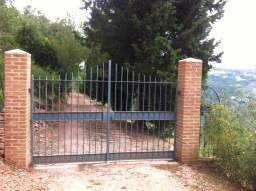
climb, and climb, the road wide enough for one and a half small cars. Then we turn onto a single lane, unpaved road, bumping and winding through a pine forest for a kilometer, when around the next corner Nadia stops to unlock the 7-foot high gate between two brick posts, that blocks the lane.
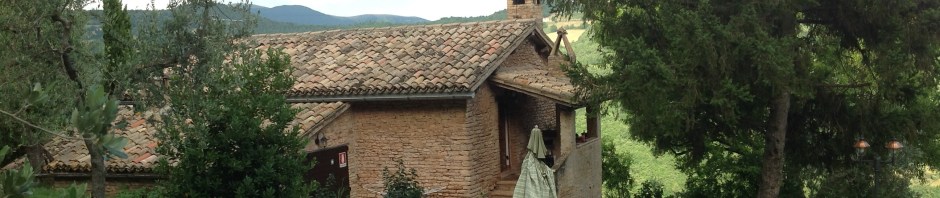
We continue on, our road etched into the mountainside, pines forming a canopy above and a steep drop through the olive fields on one side until we see the stone house perched on the hillside overlooking the valley. We peer through the evening light to see cars the size of pebbles with pinprick lights winding along the single road that traverses the valley. In the blue-to-dark evening, muted greens and olive gray
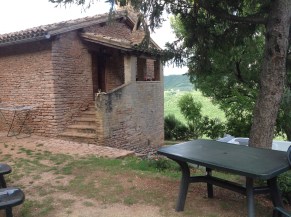
trees stretch out below.
All sounds romantic, and under the Tuscan sun, right? Nobody tells you about the bugs. What makes us think that we live here? The bugs were here first. They will be here long after we’re gone.
We climb the six stone steps up to the house. Thick wooden doors open into a single large terracotta-tiled room, framed at one end by a stone fireplace. A well blackened hearth and comforting sent of recent fires lend the room a friendly feel. Well used overstuffed chintz chairs define the living area, adjacent to the kitchen and dining half with an old wood plank table, and chests for china.
A set of steep steps lead to two bedrooms below, with their small windows, cut through the two-foot thick stone walls and makeshift screens that leave large gaps on all sides. Nadia leaves, we cook a simple pasta dinner.
Suddenly, from below, Sam shouts and we hear a slamming of something as he makes his first kill. Two-inch-long centipedes, round woodworms, hairy spiders have all come out to meet us. We begin to notice dead bugs on the floor. I hate bugs.
Next morning, we throw open the windows in the upper room. The vista is breathtaking, and the cool mountain air and warm sunlight fills the house with the sweet smell of pine, rosemary and honeysuckle. 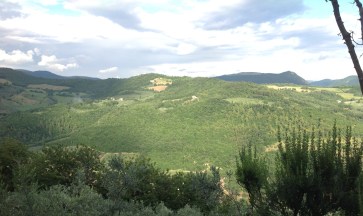 Then come the flies. Of course, there are no screens; it’s Italy!
We’re wondering what we’ve gotten ourselves into?
I don’t know about you, but nothing makes me crazier than flies circling the room as their buzzing echoes off the stone walls. Fortunately, I’d ignored William’s disparaging remarks about relying on chemical repellants, and bought 25 yards of screen material online before coming. With a bit of jury-rigging, they fit nicely over the window and door, allowing the mountain breezes to enter the house.
In daylight, we see for miles, across large valleys and lower hills crisscrossed with fields of olive trees planted on every slope. Stone houses hide in the landscape. Yellow-green fields of hay command the level spots. Only two mountain roads are visible below us, mostly hidden by trees. Beyond are the Apennine mountains, dark green shapes against the bright blue summer sky, so tall, most have tree lines giving way to meadows on their peaks.
Leaving Sam asleep, we venture out for food, driving our white Fiat 500 down the narrow driveway, through our gate, to plunge down the gravel hairpin turns that define the “short way” to get to the road. You put the car in first gear, hold your breath and execute two sharp turns at a 20-degree down angle on gravel, exiting into the road and hoping that no one is coming. Then, we travel five kilometers down the mountain to Spello, circling the massive town walls to reach the lower town.
Italian Supermarkets:
Italian supermarkets are a relatively recent invention. Unfortunately, they are driving the small food shops out of business. Spello’s supermarket is very new, located outside of the historic center, with a large parking lot, wide aisles and a good selection of food. My dreaded part of the Italian supermarket experience is the checkout. Can you get through without embarrassing yourself, or failing to pack your groceries quickly enough?
First, it’s a sin not to have some form of change for the cashier. Should you hand them a 50-Euro note for 22.63 worth of groceries, and not have at least 63-cents, or preferably 2.63, the cashier will loudly sigh about your lack of forethought, even if she has a drawer full of change. It harkens back to the extreme change shortage that plagued Italy ever since we’ve been coming. One sure way to win over any Italian cashier is to pull out all your change and let them pick out which coins they need.
Then comes the grocery packing: Should you fail to ask for enough bags before your groceries are totaled, you’re in real trouble. Bags cost 10-cents apiece, and must be purchased with your groceries. They’ll sell you another one, but not without a nasty look. Then, as they swipe your items over the bar code scanner and send them careening to the packing area, you’d better be filling those flimsy plastic bags so that by the time they announce your total, your groceries are bagged and you are not holding up the person behind you. So there you are, trying to translate the amount, pack too many items in a bag that will rip, pay and get your bags off the counter, as everyone in line glowers at you for taking too much time.
The Italian Lunch
The reward, is lunch. Sam is up by the time we return, fresh from the shower, and reporting several more “kills.”
But the sun is shining and we set the outside table for our first lunch in paradise. Tomatoes, arugula, radicchio, fresh mozzarella di buffalo make caprese salads, drenched in olive oil and balsamic vinegar with crusty fresh bread. We eat under the pine trees overlooking the valley below. Such a lunch changes your world view. Oh yes, William heats some leftover pasta from last night. The jug of red wine graces the table. The bugs no longer matter.
It’s just Sam, William and me, this amazing food, sitting outside under the pine tree with the most beautiful view. “Ben’ essere,” or the art of well being.
 Your Words Matter