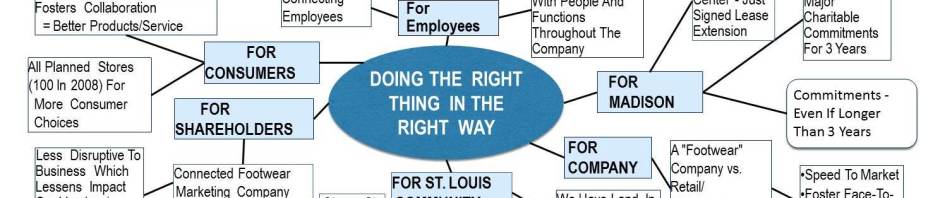
A MESSAGE MAP is a simple, visual tool that captures your MESSAGE, offers PROOF POINTS to explain the “how” and “why,” and tells audiences why they should care — what’s in it for them? The Message Map was invented by my late colleague Tripp Frohlichstein, the dean of media training. It has helped countless companies and organizations reach their customers and the public.
Our MEDIA TRAINING sessions start with a focus on MESSAGE MAPS, and how to develop them for specific interviews. Using a good message map allows you to be heard. It also allows you to stay in control for a positive outcome during an interview with the media.
1. Develop your “Home Base”.
HOME BASE is your main message. It’s your single most important communication objective (why/how you improve the lives of your customer). Knowing and communicating your HOME BASE is the most important factor in conducting a successful interview.
A question from a reporter is merely a starting point — you don’t evade it — You address it. Then you move on to discuss your own objectives and ultimately reach your HOME BASE.
2. Know your PROOF POINTS.
To just have a HOME BASE is not enough. Any company can say it “cares about its customers,” but can this be proven? Many times it cannot. A reporter was talking with one company executive who proudly pointed out that his company listened to its customers. The reporter then asked what changes had been made as a result of that customer input. The executive was stumped.
You need to develop PROOF POINTS. These are messages that support your HOME BASE. If HOME BASE is “we care about our customers,” a PROOF POINT might be “we listen to our customers.” It is a sub-message that adds credibility to your HOME BASE. Most interviews should use no more than three PROOF (although you can have many more).

3. Prove it with SUPPORTING PROOF!
Suppose that your HOME BASE is “we care about our customer,” and your PROOF POINT is “we listen to our customers.” The SUPPORTING PROOF could be “we’ve added illustrations to our instruction manuals because customers said more visual support was needed to learn equipment operations.” The SUPPORTING PROOF is the addition of illustrations to the manuals. Another SUPPORTING PROOF might be that “when calling a customer service operator, your call is usually answered within four rings.”
4. Distinguish yourself from the Others.
Now list your DISTINGUISHING EXAMPLES — what sets you apart from the others? Some companies might offer support services during normal business hours. Yours might be the only one offering weekend support, along with live operators, making that a DISTINGUISHING EXAMPLE.
DISTINGUISHING EXAMPLES also may be “hot buttons” for the audience. Although others may offer similar PROOF POINTS, it is important that the audience knows you have them too. It might be, for example, that while fairly common, a volume discount is important to customers. If so, it belongs in the interview.
5. Now … Build your MESSAGE MAP.
A MESSAGE MAP is similar to a road map in its function. It points you in the direction you want to go (HOME BASE) and tells you how to get there. What’s more, constructing a MESSAGE MAP helps you focus on the positive accomplishments of your organization. The challenge is to find all the things you are doing right.
When complete, the diagram will resemble a hub & spoke map. All routes lead home. From the central message, or home base, one spoke may focus on how employees help customers, another on the product line, another on customer service, and another may look at cost.

MESSAGE MAPS can be used to develop answers to questions from customers, the media, shareholders, colleagues and just about any other stakeholder. A MESSAGE MAP can also help organize marketing brochures and help plan a speech. A master MESSAGE MAP may be extensive. After developing it, use only the parts you need for any given situation.
In the end, using a MESSAGE MAP helps you control most communication situations by helping you know what to say while reaching your audience with what they want or need to hear in an honest, straight-forward fashion.
See workshops offered. For more information on creating a MESSAGE MAP, please email me at beth.a.fagan@gmail.com.
 Your Words Matter