
At some point, every company will experience a critical jobsite/office/plant emergency … or accusation of sexual misconduct or racial bias. Beyond rendering immediate aid, support or direction, is your frontline staff prepared to maintain your company’s/client’s messaging goals? What happens if the cameras show up before your PR team arrives?
 TV news loves accidents. Toppled cranes, overturned trucks, sinking boats, dangling girders high above the ground, fires blazing, water gushing – all make great TV news stories! These highly visual episodes, whether filmed by official news crews or bystanders with cell phones, play over and over again – often going viral – especially if the company bungles its “first hour response.”
Accusations of sexual misconduct or racial bias also are enticing news stories, particularly if a manager is identified. What’s more, media believe an “accusation” is sufficient to warrant a story as long as they include the word “accusation.”
What steps can on-site managers take if the media arrives at their door and they can’t reach the company’s communications staff? Or, if a company is too small to have a communications staff? Or, if it’s 4 p.m. on a Friday afternoon (when many crises happen)?
If a manager says “no comment,” hides, or worse, tries to physically block the camera, it can severely damage your reputation, costing untold dollars in sales. Instead, companies can invest in developing a crisis plan, professionally media-train managers, and develop in advance simple message maps that can be customized for likely scenarios.
To quote Warren Buffet: “We can afford to lose money – even a lot of money. But we can’t afford to lose reputation – even a shred of reputation.”
Rule for Crises: Mess Up … Fess Up … Dress Up.
We are all human. Companies are run by humans. Humans make mistakes. It’s how we handle those mistakes that makes or breaks our reputation. This little rule, Mess Up … Fess Up … Dress Up, is important.
- Fess up: When we mess up (have an accident or problem at a jobsite), we fess up and take responsibility. You may not have caused the problem, but it happened on “your watch” at your site. It’s proven that customers will be positively impressed when you take responsibility. You are showing concern for them.
- Dress up comes when you tell your customers, clients how you’ll learn from the accident to “make it even better” for them in the future.
Ultimately, it’s all about doing the right thing. Do what is right for those impacted — as opposed to protecting yourself — because it sends a strong positive message about who you are.
Plan Ahead
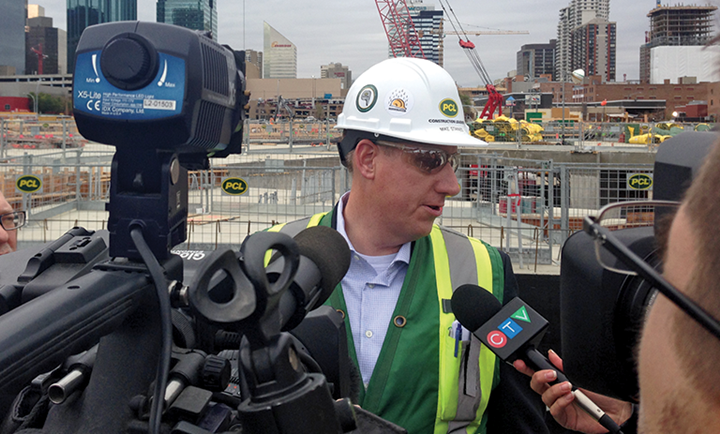 All companies need a crisis plan. Then, rehearse it. As part of that plan, spokespeople are evaluated, chosen and trained. Each spokesperson receives brief professional media training (so they know what they can say, and when/how to close their mouths).
We teach companies to use Message Maps for both everyday marketing communications, and for crises. These are tools for delivering a spoken message, consistently, to your employees, clients, customers and the media (if necessary).
For many crises, you will use a “Home Base” about safety. Remember, whatever home base you choose, it must show concern for people (blue circle). When “concern for people” is the heart of your message, it bulletproofs your answer – makes it hard to be criticized. Inversely, when “concern for yourself or your company” is the heart of your message, it makes people angry. You appear selfish and untrustworthy.
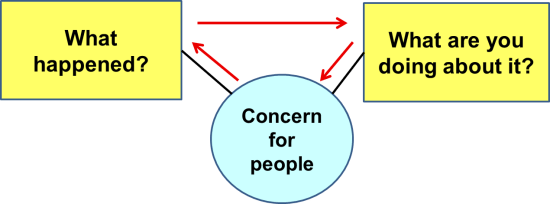
Then, surround your Home Base with “proof points” that explain how or why? In your First-Hour Message Map, the proof points must be brief: 1) Explain very briefly but truthfully what happened (why you’re fessing up), and 2) what you’re doing about it (investigating, working with authorities, etc.) in other words, how you are showing concern for people. Voila, you have a simple message map for the first hour. Thus your statement starts and ends with your company’s Home Base, its commitment to take care of people.
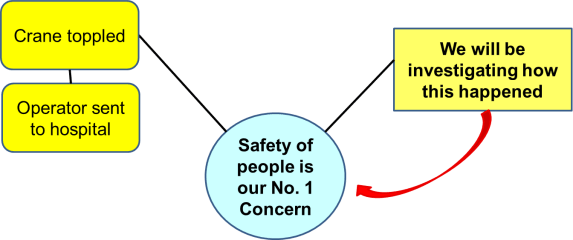
Applying this in a practical way, suppose a crane falls over adjacent to a busy parking lot: The operator is taken by ambulance to the hospital. What can you say to the TV crew? By sketching your response out on a message map, you limit yourself to what you can say. Just start and end with home base – your concern for people!
Scenario Played Out:
TV Reporter: “What happened?”
On-site manager: “First let me say that the safety of our people and everyone at the site is our No. 1 concern. A crane toppled sideways when we were repositioning it. The driver was taken to the hospital. We will be investigating how this happened. Again, our primary focus is ensuring the safety at our work site. We will have more information later.” (close mouth and get back to work)
TV Reporter: “But, how did the crane fall?”
On site manager: “We will be investigating how this happened. Again, our primary focus is ensuring the safety at our work site. We will have more information later.” (close mouth and get back to work)
Training managers to know when and how to stop talking, is critical, as is the tone used to deliver your Home Base. When you express your concern for people, it must be said with concern and conviction. The reporter and their viewers won’t believe your concern unless your spokesperson truly believes it.
It also must be true. If your company’s values don’t include concern for customers and employees, merely saying it may trigger whistle-blower actions by employees – where they call the media to say the company is being dishonest.
Message Maps for Accidents Involving Deaths
If someone dies, the public, their family, and your employees won’t forgive you if you fail to show human emotion. In fact, in the cases of such tragedy, top management should go to the site.
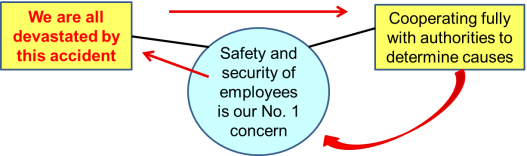
Until family is notified, it is critical that on-site statements be very brief (Again, professional media training is recommended for the on-site spokesperson). Here is the basic message map:
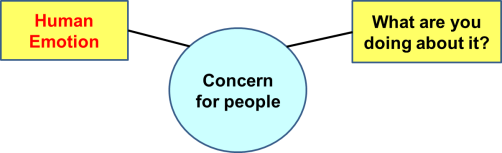
Again, your Home Base must include “concern for people,” but your first proof point is expressing emotion, sympathy, sadness for the victim. In the case of a death, police and firefighters will be on site, and your second proof point is full cooperation. Then close your mouth.
Company Follow-Up Statement
Another best practice is to plan ahead. Have outlines or statements to issue for different types of accidents. Here are a few that can be adapted as needed:
“Our first concern is always the safety and well-being of our employees and others on-site and we are investigating the incident to determine the cause.”
“We do not yet have all the details of this accident, and a thorough investigation is underway. We extend our deepest sympathy to the family of our employee.”
“Our deepest, heartfelt sympathy is extended to the friends and family of our employee, and our thoughts and prayers are with them. The safety and security of our employees is of the utmost importance to the [owner] family.”
“The number one priority is the health and safety of the American people.”
“There is no higher priority to our entire [Company] family than the safety of our customers and employees.”
“The wellbeing of our customers and employees is our top priority. We strive for “best practices” in sanitization at all our sites. We’ve closed the site where the employee worked and it currently is undergoing additional sanitizing and deep cleaning.”
Now Dress Up
Companies ultimately will be judged by how quickly and honestly they dress up, or take actions to make their products, services and responses even better for the pubic, their customers and clients. In most cases, the plan to dress up needs to be announced to your employees and customers, within 48 hours – unless it involves an act like a data breach that potentially harms many people. In these cases, the dress up must be announced simultaneously.
Key Do’s
- Do be honest. Never lie or mislead: It will keep you out of trouble, attorneys will have less to defend if your company is sued, and ultimately it will cost you less in damages.
- Do be sympathetic to those impacted and show your emotions – concern, sadness.
- Do apologize when appropriate, especially when your company’s actions have injured someone. Again, research shows companies/organizations are less likely to be sued when they apologize. Companies that fail to apologize make people angry.
- Do “double down” on the company’s values. If an organization’s values say they “put customers first,” then say it again and again … and live it.
- Do keep your employees informed. Being open with employees will earn you loyalty.
- Do the right thing!
And now the “Don’ts”
- Don’t speculate on causes. It’s always better to say you are investigating: then investigate and learn from it so you can dress up.
- Don’t give out names, especially of injured persons.
- Don’t blame. Those who blame others appear weak, dishonest, and shirking responsibility.
- Don’t smile or nervous laugh. A word of caution: as youngsters, we are trained to smile for the camera. Be sure to have an expression commensurate with the seriousness of the crisis.
- Don’t be cheap. Buy dinners for all, bring in assistance, pay overtime.
- Don’t forget to tell your client! If you are performing work on someone else’s property, call them immediately.
Importance of Not Guessing or Speculating
Leaders often feel they should have all the answers. Unfortunately, assertions based on a leader’s beliefs/wishes versus facts can cause major troubles as a news story uncovers the facts and the leader is discovered to be wrong – in other words – viewed to be either incompetent or covering-up.
If you don’t know the answer, say that: “I don’t have that information right now … please let me get back to you …”
Speculating is another danger. If an injured person is conscious as they are taken to the hospital, the temptation is to say “they had minor injuries.” But, you are not qualified to assess their injuries. You are not a doctor! Don’t speculate positively to down-play seriousness of the accident. What happens if the person dies?
Stick to the facts: “The employee was taken to the hospital.” Then close your mouth.
More importantly, such speculation diverts attention from your main message: Concern for people.
TV Reporter: “How did this happen?”
On site manager: “While we are investigating how this occurred, right now our top concern is assisting each and every person who was affected. We are doing this by 1) … 2 … and 3) …”
Complete Message Map for Safety
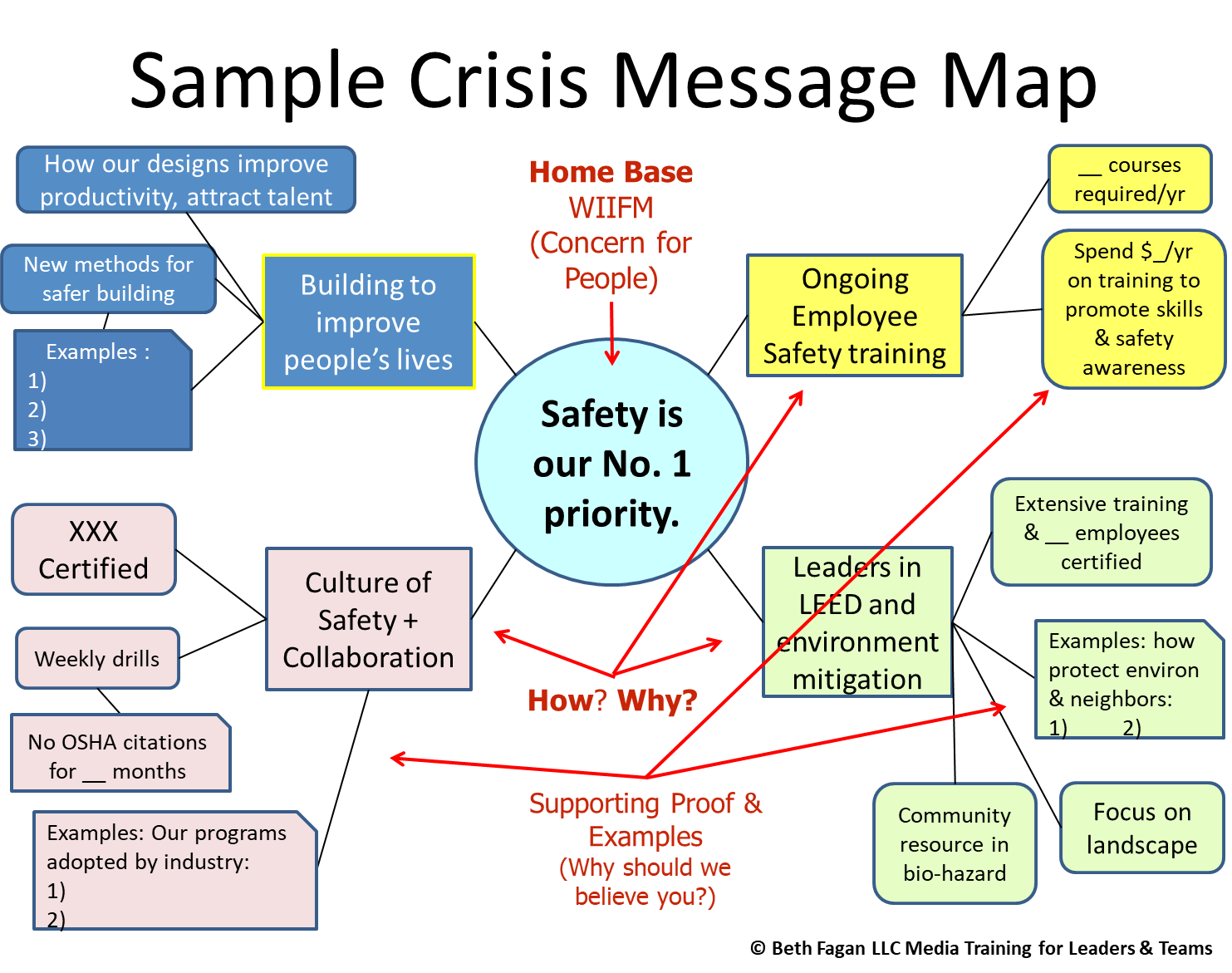
Again, your home base is concern for people, or Safety [of People] is our No. 1 Priority. In this case, there are four proof points (hows and whys). These are then supported by supporting proof (rounded rectangles) and examples (clipped-corner shapes) that answer the “why should we believe you?” question.
Plan ahead. Embrace the Mess up, Fess up, Dress up rule as a guiding communications principle for your company. Train your people. It’s all about safeguarding your reputation.
To schedule a media training workshop for your organization email Beth.A.Fagan@gmail.com or call us at 314-503-1136. (c) BETH FAGAN LLC
 Your Words Matter